
Chu Wan never expected that the young shop owner was actually Nie Nangui.
But thinking about it, it made sense. Back in 1984, his family already had quite a few old things. There weren’t many families in Beijing that could set up such a large business.
The history of the Nie family dated back to the late Qing Dynasty.
From the late Qing Dynasty to before the Liberation, bronzes were the most valuable items in the antique world. At that time, antique collectors valued bronzes from the Xia, Shang, and Zhou dynasties.
At that time, porcelain could not compare with bronze and stone artifacts. Only the porcelain from famous kilns of the Song and Yuan dynasties could fetch relatively high prices. Other porcelains were simply incomparable. A single bronze tripod vessel from the Shang dynasty could be exchanged for a pile of genuine official kiln porcelain.

The Chu family ancestors made porcelain and also jade and jewelry. When it came to the generation of Chu Wan’s great-grandfather, he was unwilling to remain unknown, so he started to do antique business. At first, he dealt in Yuan, Ming, and Qing porcelain, but he didn’t make much money from it.
Those who made a fortune were all collectors of bronze and jade. He knew the market situation and began to think about entering the bronzeware business.
To learn about bronze artifacts, one must have a solid foundation in the Four Books and Five Classics and be thoroughly familiar with the history and culture of the Xia, Shang, and Zhou dynasties. Her great-grandfather also put in a lot of effort in this area and finally got the hang of it.
At that time, several families made a fortune from bronzeware, one of which was the Nie family in Tan’er Hutong.
Going back four generations from Nie Nangui, that is, his great-grandfather’s generation, he was a Hanlin scholar in the late Qing Dynasty. Unfortunately, he was implicated and convicted, and was dismissed from office. But he was still a former Hanlin scholar and got to know a group of epigraphers in the Hanlin Academy.
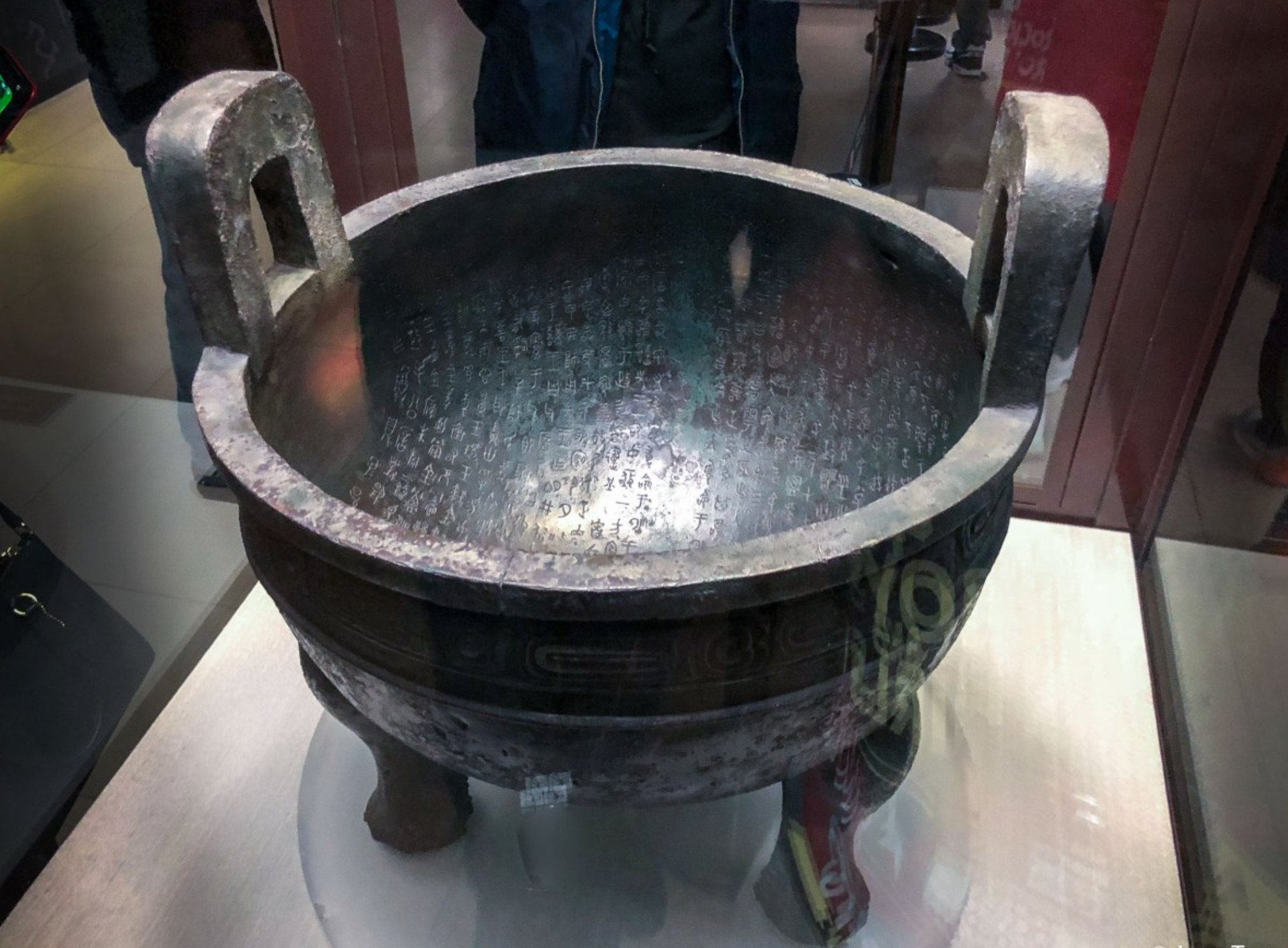
After being dismissed from his official post, he simply became an antique dealer, specializing in collecting bronzes for scholars of epigraphy and old Hanlin scholars. At that time, these old Hanlin scholars and epigraphers all loved inscriptions, and bronzes with inscriptions were the ones that could make a lot of money. This great-grandfather of the Nie family had a good foundation in the Four Books and Five Classics, and he made rubbings of the inscriptions on the Mao Gong Ding1 to imitate and engrave, becoming a master of forgery. This business flourished, and he became a well-known bronze dealer in Xi’an, also establishing the reputation of ‘Xi’an-made’ forgery bronzes.
In the 1920s, the Northwest Zhen Song Army attacked Xi’an and besieged the city for eight months. The Nie family devoted all its strength to supporting the defending generals Yang Hucheng and Li Huchen. However, the battle was difficult, the city ran out of food, and 50,000 people starved to death. The ancient capital of thirteen dynasties suffered the most tragic calamity in its history, and the Nie family was severely weakened.
Therefore, one branch of the Nie family left Xi’an and moved to Beiping (Beijing), which was the branch of Nie Nangui. Nie Nangui’s great-grandfather was a man of great influence who established himself in Beijing and became a major player in the bronzeware business, even rising to the position of vice president of the Beijing Antique Dealers Association.
In his early years, her great-grandfather, in order to broaden his knowledge, searched far and wide for rubbings of bronze inscriptions. He once befriended a descendant of the Nie family in Xi’an and spent a lot of money to obtain the inscriptions of the San Shi Pan2 and Mao Gong Ding.
Who would have known that that descendant of the Nie family was just a good-for-nothing scoundrel? Her great-grandfather spent 500 silver dollars only to be given some altered and fake inscriptions, which humiliated him. From then on, he disliked the Nie family. When the Nie family moved to Beiping, the two sides were wary of each other and maintained a facade of harmony while harboring resentment.
Later, the Nie family purchased a large number of bronze artifacts, believing them to be genuine Shang Dynasty bronzes, and spent a lot of money on them. But in fact, they were only ‘made in Suzhou’ and were actually the works of Zhou Meigu, a famous bronze casting craftsman of that time. Her great-grandfather had some connections with Zhou Meigu and knew the origin of these so-called ‘Shang Dynasty bronzes’, but he naturally kept quiet about it. Nie Nangui’s great-grandfather was fooled because of this.
Later, when Japan invaded China, a large batch of goods they were transporting from Tianjin to Jiujiang was seized by the Japanese navy stationed in Hangzhou Bay when the ship reached Qiantang Estuary. They spent money asking people for help to return it for two years without success. So a large batch of bronzes was given to the Japanese for free, and the Nie family was no longer able to purchase any more goods.
Just when Japan had finally surrendered, the Citibank vault robbery in Dongjiaomin Lane came as a shock. Several major antique dealers were robbed, and not only did each of them suffer heavy losses, but they also lost several family members. Chu Wan’s Grand-Aunt, the third young master of the Nie family, and the adopted son of the renowned French antique dealer, Léon Poirier, were all implicated.
This robbery case became infamous in the Beijing-Tianjin-Hebei region, shrouded in mystery. The Nie family deduced that the disaster was caused by her Great-grandfather’s Nine Dragon Cup, but her Great-grandfather felt that the third young master of the Nie family had conspired with outsiders to cause trouble and set themselves ablaze. As a result, the two sides no longer cared about their professional relationship and began to resent each other.
Thinking back on past grievances and affections, Chu Wan felt a mix of emotions.
Because of the unsolved Citibank robbery case from years ago, and the fact that members of both the Nie and Chu families had perished in it, there was naturally some suspicion between them.
In the years that followed, Chu Wan and Nie Nangui faced off several times, due to their ancestors’ old grudges and their inability to swallow their own pride.
… … translated by Maela @ whitemoonlighttranslations.com
However, the Nie family never regained its former glory; times had changed, and the age of bronzeware had passed.
Beautiful and exquisite, small porcelain snuff bottles were far easier to handle than heavy bronze artifacts. No matter how rare a treasure from the Xia, Shang, or Zhou dynasties may be, in the eyes of antique collectors, it was not as interesting as a piece of Xuande blue and white porcelain.
Porcelain was the Chu family’s original business.
There were two reasons why she was able to obtain the Ming Dynasty blue and white porcelain from Nie Nangui and escape unscathed. First, she benefited from being reborn, and Nie Nangui was still a bit inexperienced at this point in time, so he naturally suffered a loss. Second, the Nie family was still lacking in expertise in porcelain, and did not have the profound family tradition of the Chu family.
Thinking of this, Chu Wan reached out and touched the five jade beads in her canvas bag. She took out the Han Dynasty yellow jade bead. Under the sunlight, the jade bead was as soft as grease, delicate and moist, and its color was as rich as beeswax. Such a jade bead was truly rare.
She examined it carefully and noticed that there was a small hole on the yellow jade bead. The hole was very neatly made, and there was a small arc at both ends. Such workmanship was truly rare.
This was clearly the head bead of a court necklace.
Court necklaces were worn by Qing Dynasty officials when attending court. The color varied according to their rank. In the early years of the Republic of China, after the Qing government collapsed, a large number of court beads appeared on the antique market. These court beads were of all kinds and had different prices. In the past, some court beads were kept in the bottom of people’s chests. They were mixed with ordinary jade beads and were not rare.
However, this particular Hetian yellow jade bead could only be used by one person at that time: the emperor. According to historical records, this court bead was exclusively used by Emperor Qianlong for sacrifices at the Temple of Earth.
This added even more value than ordinary yellow jade beads; although she only had one, it should not be underestimated.
According to her initial assessment, after ten years, with some hype, two million was probably a realistic possibility.
Seeing this, Su Hongyan said curiously, “Your bead is pretty, it looks like a roasted, little, yellow chestnut.”
Chu Wan smiled, casually rubbed it with her thumb, and then carelessly put it back in the canvas bag. “It’s quite pretty, just keep it to play with.”
She thought to herself, if Nie Nangui knew that she had obtained a blue and white porcelain jar and a Qianlong imperial court bead right under his nose, he would probably be furious.
Regardless of the reason, she won her first encounter with Nie Nangui completely.
Chu Wan thought of Old Man Nie again. That man had a truly sharp eye. It was only because he wasn’t around today that she was able to get such a great deal.
At this moment, Su Hongyan carefully held several jars, naturally treasuring them and feeling somewhat proud, thinking that she had ‘found something’.
Lu Jianzhao said, “Logically speaking, even if it’s a Qing Dynasty imitation, Qing Dynasty blue and white porcelain is still valuable!”
Chu Wan carefully put away her five beads before slowly saying, “For a Qing Dynasty imitation of a Yuan blue and white porcelain, 150 yuan is still acceptable.”
Su Hongyan exclaimed excitedly, “That’s it! I found it!”
Chu Wan asked, “But judging from that shrewd shopkeeper just now, do you think it’s possible for you to get a bargain from him?”
Su Hongyan thought it made sense, but she quickly added, “Isn’t that because you’re amazing!”
Chu Wan said, “No matter how capable I am, that person would never let someone take advantage of him. People don’t do things that don’t benefit them.”
Lu Jianzhao frowned upon hearing this. “Wanwan, what do you mean?”
Chu Wan: “Although this is a Qing Dynasty imitation of a Yuan Dynasty porcelain, the colors were done during the Republic of China period. The decoration work was not even done well, so its price was greatly reduced.”
Su Hongyan: “Huh?”
Lu Jianzhao asked in surprise, “How much is it worth then?”
Chu Wan thought for a moment, “About 10 yuan?”
Su Hongyan almost choked on her breath, “What?”
Lu Jianzhao was also dumbfounded, his eyes wide. “Wanwan, what does this mean? We spent 150 yuan on something that costs a dozen yuan? Isn’t this just giving money away?”
Chu Wan said, “Don’t rush to judge, let’s go to a quiet place and talk slowly. Hold onto your things tightly, don’t drop them.”
Upon hearing her reminder, Su Hongyan quickly secured her hold.
Pearls and Jade Beside Me in the ’80s translated by Maela @ whitemoonlighttranslations.com
Chaozhu or Court Necklace was an essential part of imperial court attire. It was originally based on the 108 Buddhist prayer beads but later became less a religious item and more a sign of status and rank.
The ‘head bead’ that Chu Wan found would be the major one called ‘Buddha’s head’ that sits at the back of the wearer’s neck; a dangling pendant is attached to it acting as counter-balance so that the necklace sits comfortably on the wearer. She knew it was worn by the emperor because they were the only ones who could wear this shade of yellow.


Enjoying my translations? Check out my Patreon to get advance access to all ongoing translation works, single work only, or bundled works. Or just leave a tip! Thanks for your support.
FOOTNOTE:
- ‘Mao Gong Ding’ or ‘Lord Mao’s Cauldron’ is a bronze tripod vessel from the Western Zhou dynasty (c. 1045 – c. 771 BCE). It has an inscription of 500 characters arranged in 32 lines, the longest inscription among the ancient Chinese bronze inscriptions. It is currently housed in the National Palace Museum in Taipei after the retreat of the Republic of China government to Taiwan where it is considered one of the ‘3 Treasures’.

↩︎ - ‘San Shi Pan’ or the ‘San Family Plate’ is an ancient Chinese bronze water vessel from the late Western Zhou dynasty.The interior features 357 characters of ancient bronze script spread across 19 rows.

↩︎

Leave a Reply